
101CAFFÈ Rennes · Coffee guide
The ideal blend: Robusta and Arabica coffee for exceptional flavour
Arabica or Robusta: discover the differences in flavour, body and caffeine, and how to choose the right blend for your espresso.
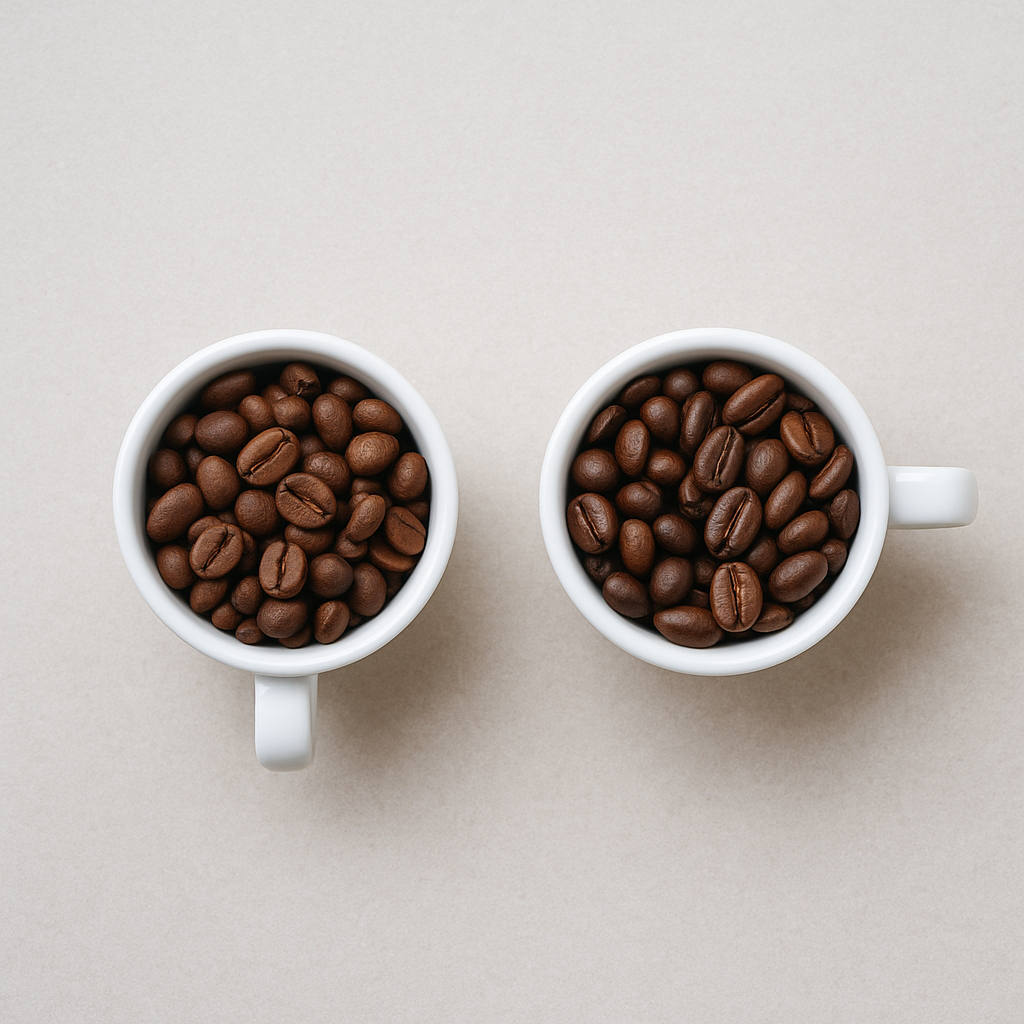
Arabica and Robusta do not deliver the same sensations in a cup: the former is often sought for its aromatic finesse, the latter for body, intensity and its contribution to espresso crema. Blending them lets you balance these features, provided the proportions match your taste and brewing method.
Which Arabica–Robusta blend should you choose? For mild, aromatic coffee, start with 80% Arabica and 20% Robusta. For a stronger Italian espresso with more body, try a blend of 40% Arabica and 60% Robusta. There is no universal ratio: bean quality, roast, grind and extraction matter just as much.
Arabica and Robusta: what are the differences?
We commonly speak of two “varieties”, but more precisely they are two coffee plant species : Coffea arabica and Coffea canephora, whose best-known commercial name is Robusta. Their cup profiles also depend on origin, cultivation, post-harvest processing and roasting.
Scroll horizontally to read the table →
| Criterion | Arabica | Robusta |
|---|---|---|
| Common aromas | Floral, fruity, chocolatey or indulgent depending on origin | Woody, spicy, cocoa-like or more intense depending on beans |
| Mouthfeel | Often more finesse and brightness | Often more body and bitterness |
| Caffeine | Generally lower in the bean | Generally higher in the bean |
| Espresso | Aromatic nuances, complexity | Body, intensity, contribution to crema |
These features are tendencies, not absolute rules. Carefully grown and roasted Robusta can be high quality; Arabica is not necessarily mild.
Does Robusta really contain more caffeine?
Generally, yes: Robusta beans contain more caffeine than Arabica beans. However, saying that a cup of Robusta automatically contains twice as much caffeine is misleading. Results also depend on dose, grind, recipe and extraction method. Studies find different gaps depending on preparation.
Is Robusta always more bitter?
It often has a stronger profile, but bitterness also comes from roasting and extraction. An over-extracted espresso can be bitter even when made from 100% Arabica. To choose, it is better to describe the cup you want — mild, rounded, bright or full-bodied — than definitively rank one species as “better”.
What percentage of Arabica and Robusta should you choose?
Proportions are a good starting point. In the table below, the first percentage always denotes Arabica and the second, Robusta. This convention avoids a common confusion when referring to a “60/40” blend.
Scroll horizontally to read the table →
| Arabica / Robusta | Desired profile | Best for | Example |
|---|---|---|---|
| 100 / 0 | Aromatic expression of Arabica | Lovers of single-origin coffees and nuances | Depends on origin and roast |
| 80 / 20 | Balance between mildness and body | Everyday espresso, long coffee | 101CAFFÈ Gran Milano |
| 70 / 30 | More presence without masking the aromas | Those who want a versatile espresso | A blend to look for according to your tastes |
| 40 / 60 | Intensity, body and stronger character | Fans of full-bodied espresso and milk drinks | 101CAFFÈ Sicila |
Profiles are indicative: two coffees with the same ratio can taste very different.
A full-bodied example: Sicila, 60% Robusta and 40% Arabica
The 101CAFFÈ Sicila coffee beans illustrate the style sought by fans of rich Italian blends. Its stated composition of 60% Robusta and 40% Arabica emphasises mouthfeel. The product page describes a woody, spicy, lightly chocolatey profile particularly suited to a bold espresso.
Sicila — 60% Robusta / 40% Arabica · beans, 500 g. Consider it if you enjoy powerful espressos, a moka coffee with strong character or a coffee base that remains perceptible with milk.
To start, set grind and dose according to your equipment. A recipe that is too concentrated or over-extracted can accentuate bitterness: adjust gradually rather than judging the blend on a single extraction.
A milder example: Gran Milano, 80% Arabica and 20% Robusta
At the other end of this selection, 101CAFFÈ Gran Milano combines 80% Arabica with 20% Robusta. Its description highlights a lighter cup, floral and biscuit notes and a rounded sensation. It is a good starting point for someone who wants the character of Italian espresso without maximum intensity.
Gran Milano — 80% Arabica / 20% Robusta · beans, 500 g. Try it for a milder espresso, long coffee or extraction suited to a bean-to-cup machine.
The right choice depends above all on your palate: if Sicila seems too intense, Gran Milano is a logical option. If Gran Milano lacks strength for your taste, a blend richer in Robusta is worth trying.
How to prepare an Arabica–Robusta blend well?
With an espresso machine or automatic machine
For espresso made with a portafilter, one possible starting point is about 18 g of ground coffee for 36 g of beverage, then adjust grind size according to the cup and machine. This is a starting point, not a requirement: every bean and appliance reacts differently. On an automatic machine, begin with a medium intensity before changing the grind, one notch at a time and according to manufacturer instructions.
With an Italian moka pot
A moka pot showcases full-bodied blends well. Use a grind suited to moka, fill the filter without tamping and follow the manufacturer’s water and heating instructions. Moderate heat and stopping at the right time avoid unnecessarily prolonging extraction. Also discover our selection of Italian moka pots and Bialetti coffee makers.
With filter or French press
A blend rich in Arabica is often an accessible starting point for these methods, but nothing prevents using Robusta. Choose a suitable grind, observe the result and adjust the coffee amount if the cup seems too weak or intense. Precision in the ratio matters less than consistency in preparation.
Cultivation and quality: is Robusta more sustainable?
Coffea canephora is often more tolerant of certain hot, humid conditions, and some varieties resist diseases such as coffee leaf rust better. This does not mean that all Robusta is grown without pesticides or automatically has a better environmental footprint. Growing location, farming practices, yields and supply chains are decisive.
Aromatic quality is not simply a matter of species name either. Well-harvested, processed and roasted Robusta can contribute to an excellent blend. For more on the history and cultivation of this species, consult the work of World Coffee Research on Robusta.
Three common mistakes when choosing a blend
- Confusing the proportions. A blend of 60% Robusta and 40% Arabica is not a “60/40 Arabica–Robusta” blend. Check the order on the product page.
- Attributing all flavour to species. Origin, roast, freshness, grind and preparation greatly affect the result.
- Choosing solely by advertised strength. Body, bitterness and caffeine are not synonyms. A coffee can be full-bodied without being the best match for you.
Explore our entire selection of coffee beans, including our 100% Arabica coffees and 1 kg formats, then choose a profile according to your brewing method. If you are in Rennes, the 101CAFFÈ team can also guide you based on your tastes and machine.
Frequently asked questions about Arabica and Robusta
What is the best Arabica and Robusta blend for espresso?
There is no universal blend. An 80% Arabica / 20% Robusta often suits those seeking balance and aromas. For greater body and strength, 40% Arabica / 60% Robusta may suit you better.
Does Robusta contain more caffeine than Arabica?
On average, yes, in the bean. But caffeine in your cup also depends on the amount of coffee used and extraction method.
Is 100% Arabica coffee necessarily better?
No. “100% Arabica” describes the species used, not a quality score. A well-designed Arabica–Robusta blend may suit Italian espresso lovers better.
Can you use an Arabica–Robusta blend in a bean-to-cup machine?
Yes, if sold as beans and suitable for your machine. Adjust the grind according to the machine’s instructions and observe the result in the cup.
Which blend for cappuccino?
A fairly full-bodied blend containing a significant share of Robusta can retain a stronger aromatic presence once milk is added. If you want a milder cappuccino, a blend richer in Arabica may suit you better.
Sources and method
This guide combines documented general characteristics of coffee species and the compositions stated on 101CAFFÈ Rennes product pages. Product flavour profiles come from their commercial descriptions: they are not an independent tasting protocol. References: World Coffee Research — History of Robusta ; Influence of Various Factors on Caffeine Content in Coffee Brews (2021).